1 · Problem: correlated blindness is not a capability deficit
A recurring assumption in agentic system design is that deliberation quality scales with model capability — that a stronger reviewer, a stronger planner, a stronger critic yields better collective decisions. This assumption fails for a specific and common class of systems: those in which every deliberating agent is an instance of the same model lineage.
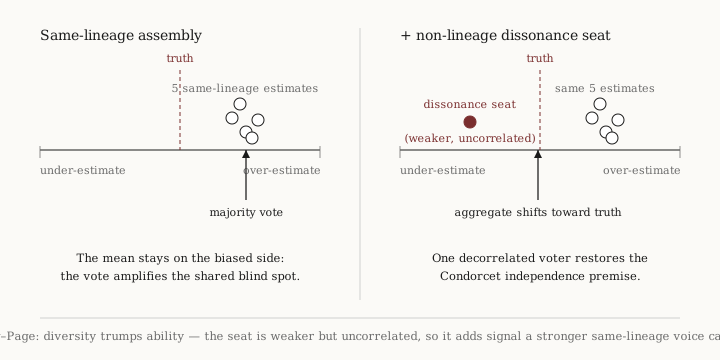
The failure is not about how good each agent is; it is about how correlated their errors are. If reviewer, implementer, tester and orchestrator all descend from the same pre-training distribution and the same post-training, then what one cannot see, the others structurally cannot see either. Adding a stronger same-lineage agent reduces variance in the wrong direction: the collective becomes more articulate and more confident about the same blind spot. When the collective then votes on its own governance — which adjustments to adopt, which process to change — the vote does not aggregate independent signal. It manufactures consensus. This is the multi-agent analogue of an epistemic monoculture.
2 · Empirical finding: the deliberation that never happened
The Soviet Dev Framework is a production multi-agent framework in which six role-agents (a chess-piece taxonomy: orchestrator, reviewer, backend, frontend, tester, release) coordinate through a persistent blackboard. It ships a formal deliberation skill — a four-voice council (Skeptic, Pragmatist, Critic, in-context synthesis) — explicitly intended for ambiguous, hard-to-reverse decisions, and whose own documentation names "premature consensus" as its primary anti-pattern.
Querying the blackboard's audit store across the full operational history yielded a stark result:
- 0 of 98 tasks carried any
council:*entry. The formal deliberation mechanism had never fired. - The single traceable governance adjustment in the system's history had been produced by an informal deliberation, not the council.
-
0keys for any dissonance / extended-critique mechanism the framework nominally provides. - Meanwhile the reviewer agent had issued verdicts on 62 tasks (≈85% blocking historically) — decision pressure was high; convened dissent was absent.
The council had not failed loudly; it had simply never been reached, because its convocation criteria were strict and the orchestrator resolved ambiguity in-context. The echo chamber was not a hypothesised risk — it was the observed operating mode, invisible precisely because nothing was instrumented to make it visible. The most important property of this finding is that it was telemetry-grounded, not introspective: the system could not have discovered it by asking itself.
3 · Mechanism: the asamblea retrospectiva
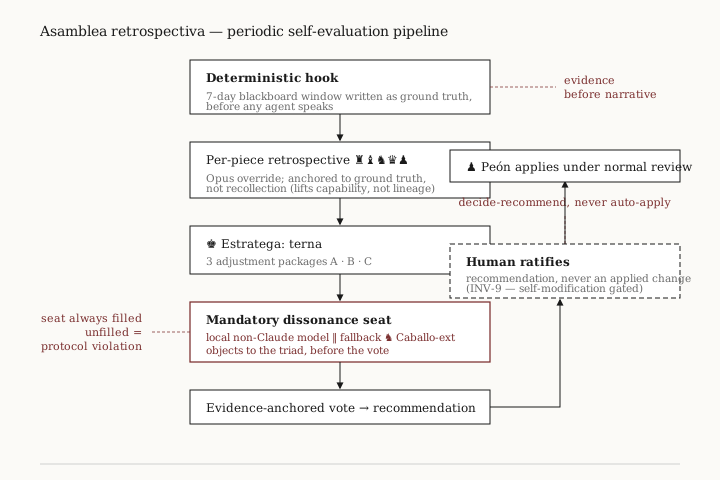
We introduce a periodic retrospective assembly — distinct from per-decision council — with four non-negotiable properties.
3.1 Evidence before narrative. A deterministic hook computes a fixed-window (7-day) retrospective directly from the blackboard (block/pass distribution, repeated-verdict tasks, reverts, per-agent operation volume) and writes it as ground truth before any agent speaks. Each agent's self-retrospective must be anchored to that record, not to its own recollection — closing the door on the favourable self-narration that same-lineage introspection invites.
3.2 Capability lift is acknowledged but explicitly insufficient. Agents reflect with a stronger model override than their normal operating tier. We state plainly that this mitigates capability and not lineage: a stronger Claude is still a Claude. This is why (3.3) is mandatory rather than optional.
3.3 A mandatory dissonance seat, occupied by a non-lineage model. Before the vote, a designated seat must object to the strategist's triad of adjustment packages. The seat is filled by a decorrelated, locally-hosted, open-weights model of a different lineage (in our deployment, a Qwen3 tag selected per-hardware; see §5). Its output is advisory objection, never authority — it is weaker than the orchestrator and must never decide or produce shipped artefacts. If no local model is available the seat degrades to an in-lineage extended-critique mode, but the seat is always filled: an unfilled dissonance seat is a protocol violation, not a no-op.
3.4 Decide-recommend, human-ratify. The assembly's vote produces a recommendation, never an applied change. A human ratifies; only then is each adjustment applied under its normal review discipline. Self-modification without a human gate is precisely the risk that disqualified a heavier autonomous-runtime alternative during design; the assembly is built so that the collective can propose changes to itself but cannot enact them.
4 · Result: a weaker model changed the decision
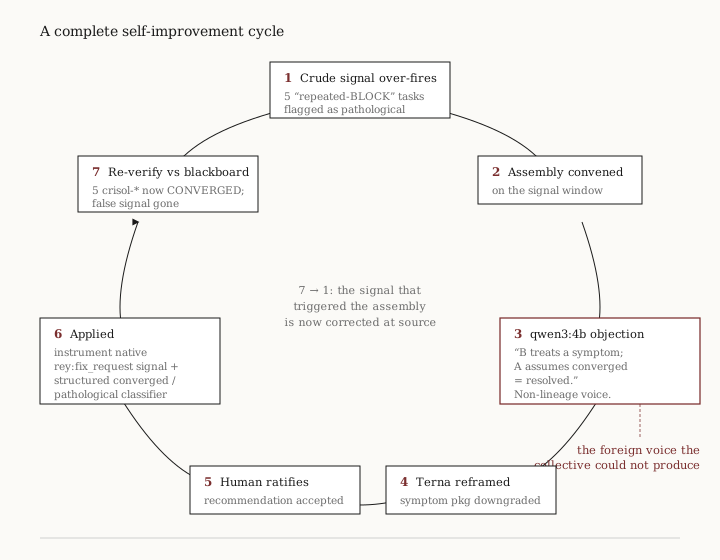
In the first live run the assembly convened on a real signal window. The strategist produced three internally-coherent adjustment packages. The dissonance seat — a 4-billion-parameter local model, strictly and obviously weaker than the orchestrating model — was given the triad and the ground truth and asked only to object.
Its objection was rough in prose but structurally decisive on three points: (i) one package assumed that a two-round "resolved" verdict was genuinely resolved rather than rubber-stamped; (ii) the packages treated agent overload and revert latency as independent when one plausibly caused the other; and (iii) one package was symptom-treatment — it mapped a symptom to a label without addressing why the underlying signal was invisible. The evidence-anchored vote, with that objection on the table, downgraded the symptom-treating package to a deferred dependency and reframed the winning package to include a verification step it had lacked. A same-lineage vote had been on track to ratify the tidy original triad.
The episode then closed on itself. The ground-truth signal that triggered the assembly was itself over-firing: five "repeated-verdict" tasks the heuristic had flagged as pathological had in fact all converged healthily. The winning package was precisely the fix for that crudeness. After human ratification the system instrumented the missing native signal and replaced the crude heuristic with a structured classifier; re-running against the real blackboard, the five tasks now classified as converged and the false signal disappeared. The assembly had used a non-lineage objection to detect the crudeness of its own instrumentation, proposed the correction, had it ratified, and verified the correction against real data — a complete self-improvement cycle whose integrity depended on the one voice that was not of its lineage.
5 · Why a weaker model is the right occupant
The result is counter-intuitive only if one expects the seat to out-reason the collective. It does not. The relevant theory is about aggregation, not individual strength:
- Condorcet jury theorem. Majority aggregation improves on the individual only when voters are independent. Correlated voters make the vote amplify the shared bias. A same-lineage assembly violates the independence premise by construction; a non-lineage seat partially restores it.
- Hong & Page, "diversity trumps ability." A collective of diverse-but-weaker problem solvers can outperform a collective of strong-but-similar ones. The seat contributes decorrelated error and decorrelated insight, not superior judgement.
The operational consequence is sharp: do not staff the dissonance seat with a stronger model of the same kind, and do not let a weaker model's objection become authoritative. Its job is to surface what the correlated voices cannot, advisorily; the collective and the human still decide.
Locality matters independently. A self-hosted model adds zero data-exfiltration surface, no recurring cost and no rate limit; a hardware-adaptive selector picks the largest viable non-lineage tag for the host so the mechanism is portable across heterogeneous machines without committing a machine-specific choice to shared configuration.
6 · Threats to validity
The evidence base is a single framework and a single first run; the quantitative claim (that the objection changed the outcome) is causal-by-inspection, not a controlled comparison. The dissonance model's prose quality is low and its objections require interpretation; treating its output as anything but advisory would degrade decisions. The convergence between the assembly's self-finding and its own fix is intellectually satisfying but should be read as one validated instance, not a general guarantee. Longitudinal evaluation — does the seat keep changing outcomes, and in a direction humans endorse — is the necessary next step and is deliberately gated behind a measurable success criterion before the mechanism is considered load-bearing.
7 · Conclusion
A self-evaluating multi-agent system that shares one model lineage cannot audit its own monoculture by introspection or by a stronger model of the same kind; the corrective signal must be telemetry-grounded and the corrective voice must be lineage-decorrelated. We showed an instance where the formal deliberation mechanism had never once engaged across the full operational history, designed a retrospective assembly whose dissonance seat is mandatory and non-lineage, and observed a strictly weaker local model change a governance decision a same-lineage vote was about to rubber-stamp — then watched the system correct an instrumentation flaw the assembly itself surfaced, verified against real data. The contribution is not a model or an algorithm but an architectural stance: in any agent collective permitted to propose changes to itself, decorrelation is a first-class, non-optional element, and the cheapest, weakest, most clearly foreign voice in the room is the one that prevents the most expensive failure — the collective quietly agreeing with itself.
Companion & artefacts
Companion: dissonance-seat-paper-es (Spanish).
Mechanism: docs/asambleas/README.md, skill
asamblea-retrospectiva, hook
daily-assembly.sh, selector
scripts/asamblea/select-dissonance-model.sh. First
assembly of record: docs/asambleas/2026-05-16.md.
Genealogy of the rejected heavier alternative:
docs/external_dependencies.md
(NousResearch/hermes-agent, rejected;
ollama-dissonance-seat, active).